Cubit Easy Hangers vs Mini Dougs
Cubit Easy Hangers earned a place in the middle of my solo tongue and groove ceiling job. My scrap-built Mini Dougs still have a job, too. Neither field holder solves the opening and closing rows by itself. Here’s what changed when I put the bought hangers to work.
Disclosure: Jared Harrelson at Cubit Tools sent me a four-pack of Easy Hangers as a gift. This is my firsthand account of using them. I don’t have an affiliate arrangement with Cubit.
A solo ceiling trial, from the first row to the last
Working alone gives you three different board-holding problems: getting started, moving through the open run, and closing up the last courses. I want an answer for all three before I call the setup sorted.
Doug came first
The first Doug was a short piece of Douglas fir 2×4. A helper didn’t show up for a solo ceiling install, so I nailed that piece up at one end to hold the end of the board while I seated the rest.
When my boss asked how the day went, I told him nobody showed up, but Doug stepped in. Doug Fir. Good guy—held the board up all day, didn’t complain, and did it well.
That was Doug. A piece of wood doing the job the missing set of hands should have been doing.
Then came the traveling Dougs
Wrestling 17-foot nickel-gap PVC overhead by myself led to the next version. I copied the idea of a commercial board holder out of scrap: clothespin-style clips that hold the boards up while I work. Those are the Mini Dougs, or my traveling Dougs.
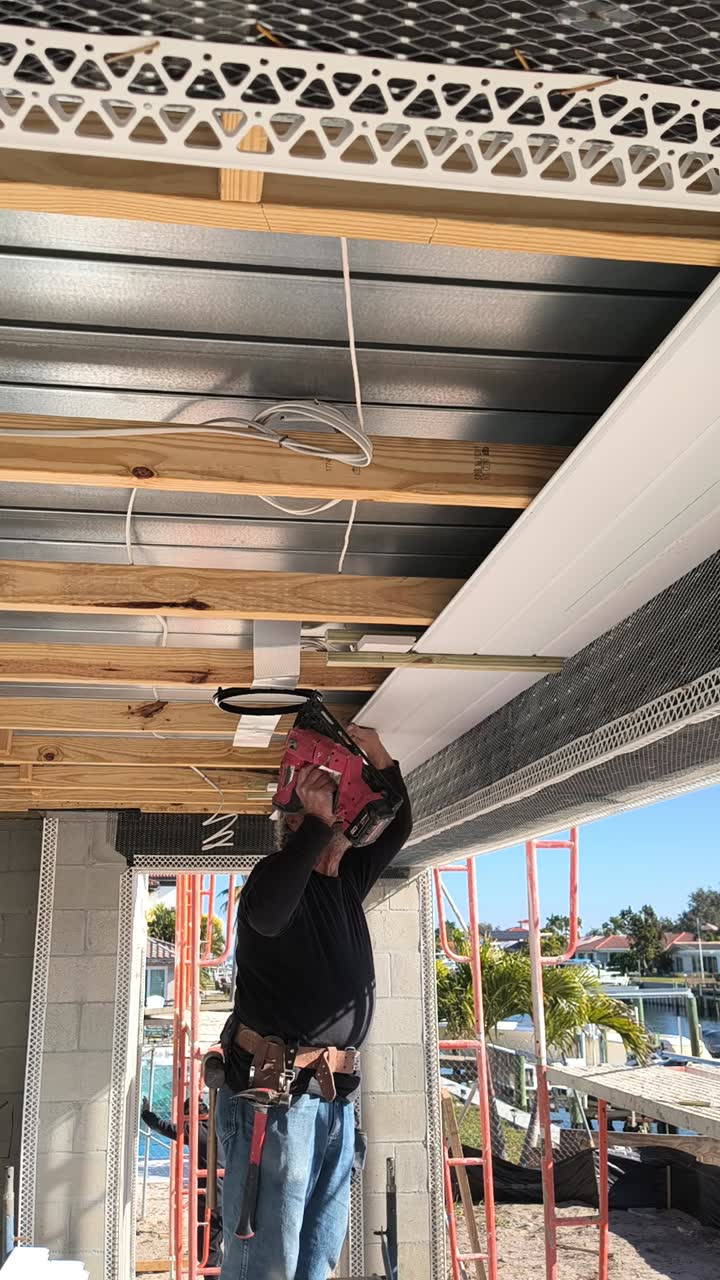
They’re part of my solo installation setup. The still below is from my own clip on a different installation. The clips are supporting the board while I fasten it; this is not a picture of the Easy Hanger trial.
I’ve also added a starter Doug that turns around to become a finisher Doug for the last couple of rows. That support has a different job from the traveling clips. The family grew because the work kept handing me a different problem.
The Easy Hangers got a real job
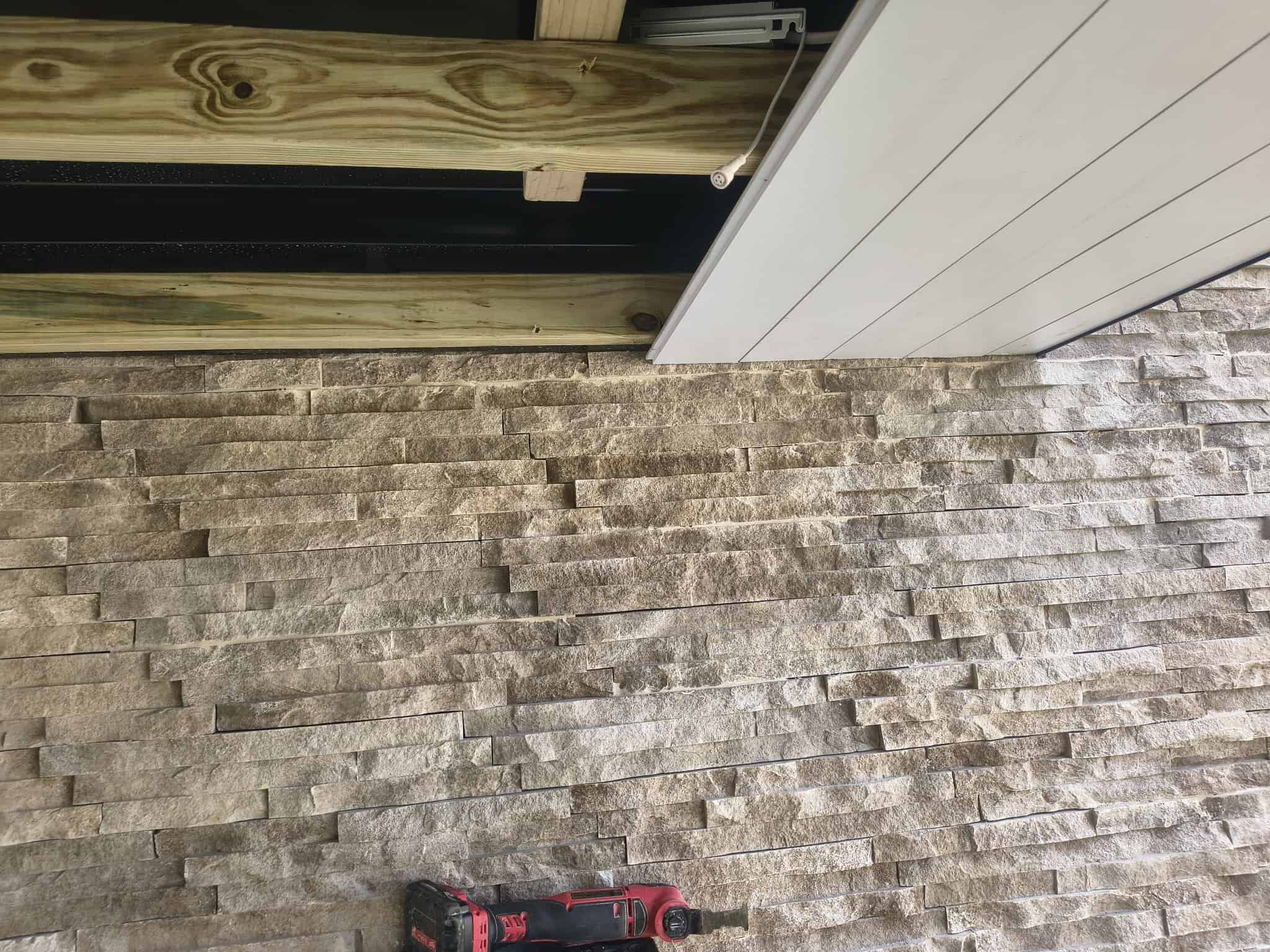
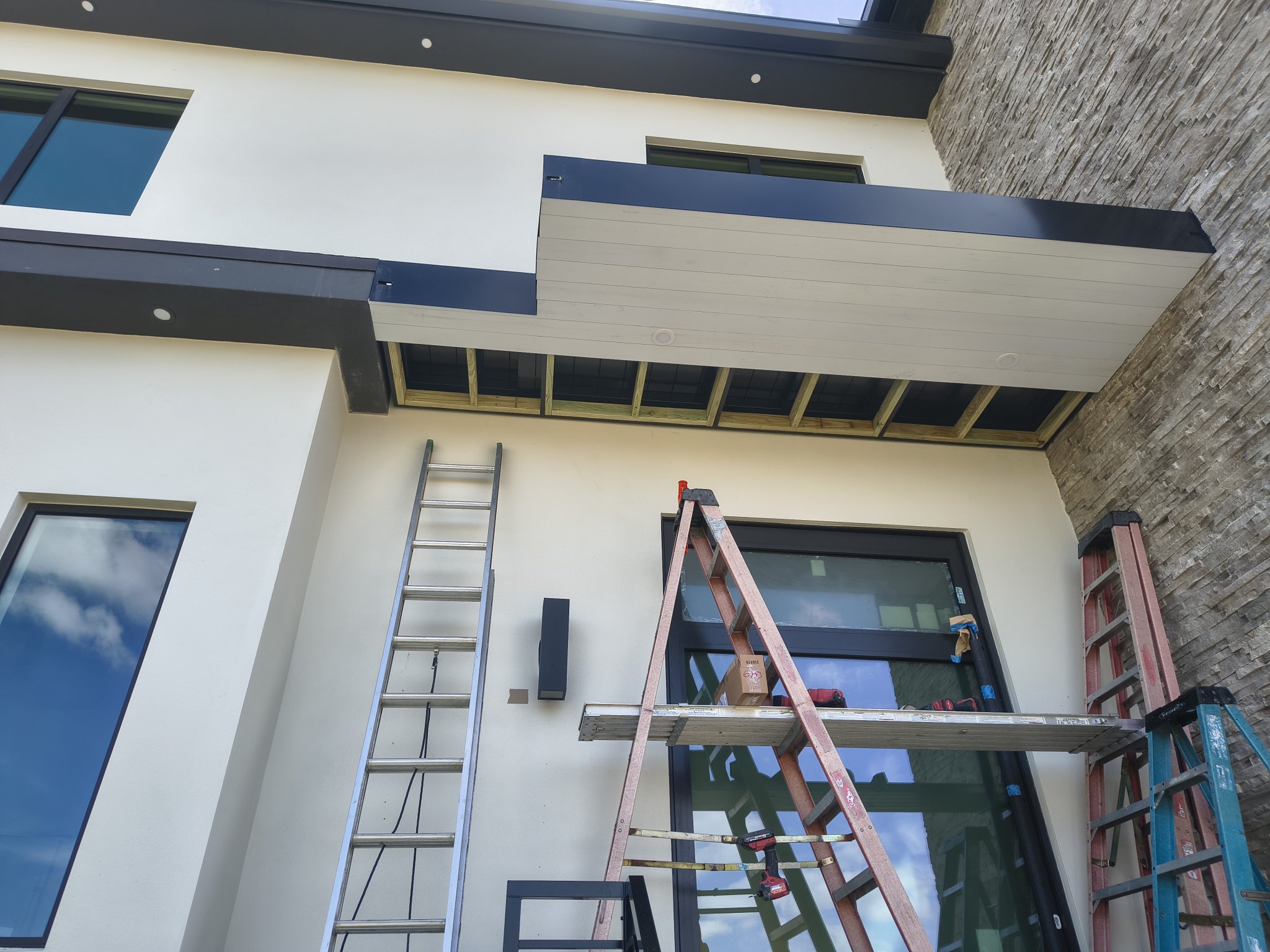
Then the Easy Hangers arrived. I used them on a PVC ceiling under a metal-framed entry canopy, working around a stone veneer wall. I was alone on that job, too.
The framing was its own problem. I covered the wood backing and the bearing plane in tongue and groove on metal framing. Here I’m comparing the holders, not repeating the framing method.
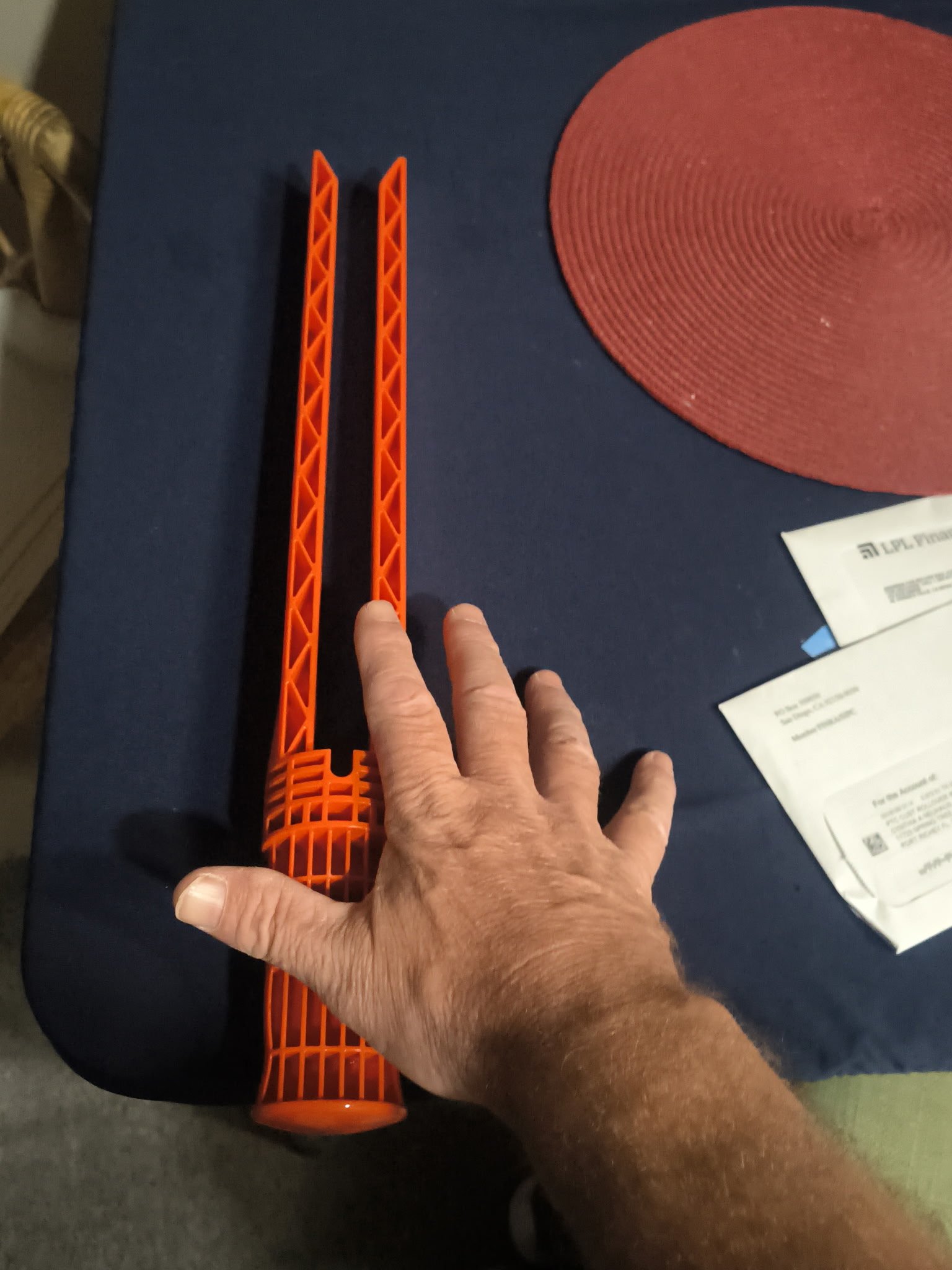
The bench photo gives you a real look at the Easy Hanger, with my hand for scale. The useful test was what it let me do once I got it overhead.
The first rows still need their own support
On this job the Easy Hangers didn’t serve the first row or the first few rows. There wasn’t anything established for them to work against. My Mini Dougs have that opening-row limit as well.
That’s where a starter Doug belongs: holding the end up while those opening rows go in. I don’t give my own clips a pass just because I made them. If there is nothing for a field holder to work against, buying one or building one hasn’t solved the start.
The rule I follow
Work out the start and the finish separately from the field. A holder that helps through the middle hasn’t answered either end of the ceiling.
Around the stone, I liked the hangers
The middle of the run was where I liked using them. Around the stone, I could put one or two up to help pinch the board while I worked that junction. That gave me flexibility I wouldn’t have had without them.
That is a description of the help they gave me at the stone, not a hanger-count instruction for somebody else’s board. Board length, material, tool version, support and access still have to suit the manufacturer’s directions.
The notch was another useful part of it. For seating the tongues on this job, it was a lot less cumbersome than my traveling Dougs. They were easy to carry and easy to store, too.
I want to use them on a bigger job. For this comparison, the evidence is the canopy: the help at the stone, the seating notch, and carrying and storing the tools.
The last three courses were a different fight
The Easy Hangers stopped serving again over the last three courses. My general answer for the closing rows is to flip the starter Doug around and use it as the finisher.
That isn’t how I got through the finish on this canopy. I muscled through it.
Access made the closing work worse. The ladder couldn’t get close enough, so each closing board meant getting down off the plank, walking around, going up the ladder, and finishing that section from there. Then doing it again.
I had two big stepladders, a 24-foot extension ladder, an expandable plank and a 6-foot ladder for stepping up. The job wasn’t big enough to bring my full scaffold system. That’s the equipment I used, not a layout to copy from the photograph; the access has to fit its rated use and the actual support conditions.
The holder’s limit was one problem. Getting myself to the last boards was another. I wouldn’t blame the Easy Hanger for that ladder commute. Next time, I want the closing support and the place I’ll stand worked out before I get there.
What the canopy trial actually settled
Here is the division of work I’d carry forward from it. The starter and finisher are separate support roles; the two field-holder choices are the Easy Hangers and the Mini Dougs.
| Part of the job | Easy Hangers | Mini Dougs |
|---|---|---|
| Opening rows | Separate starting support needed | Separate starting support needed |
| Field | Pinch help at the stone; less cumbersome seating notch | Scrap-built traveling clips; more cumbersome for seating on this job |
| Closing rows | Stopped serving over the last three courses | Plan a separate finish; my starter Doug can flip, but I did not use it on this canopy |
What I’d use for another solo ceiling
Already have holders that do the job? Start there. My Mini Dougs are still useful. Making the clips from scrap can make sense if you’re comfortable making and checking the support for your own job.
What the Easy Hangers added for me was the flexibility at the stone and a less cumbersome way to seat the tongues in the field. Easy carrying and storage matter when the tools are going up and down with me.
Build the Dougs and you’re making the support as well as using it. I’m showing what mine do here. This isn’t a dimensioned build plan, and a still from the job doesn’t give you a connection detail or a load rating.
Check the fit before you buy
I’d look at the Easy Hangers from Cubit Tools if those field jobs are what you need help with. Check the actual version and material fit, and use Cubit’s installation instructions for clearance, support and handling. The four-pack I received isn’t a reason to guess which version will fit your boards.
Before choosing a holder, check whether it can actually reach around the plank in your assembly. Cubit’s instructions require clearance for the arm; a finished ceiling tight behind the board changes that question. A good review on somebody else’s framing doesn’t establish a fit on yours.
For the rest of the kit, my ceiling installation tools guide puts the holders alongside layout, cutting, fastening and access. They are one part of a solo setup.
I’d keep the starter/finisher solution in either case. The Easy Hangers earned the field work on this canopy. They didn’t make the first row or the last row somebody else’s problem.