
Creative Uses for Leftover Tongue and Groove Wood
Leftover tongue-and-groove wood can look like scrap in a hurry. Before it gets tossed, look at what length is left, what shape it is in, and whether it still has a useful job in it.
A pile of six-inch cutoffs is one thing. Three-foot and five-foot pieces are another. Full boards left from an over-order are something else again. Treating all three piles like the same material is how good stock either gets wasted or turns into clutter.
That is where leftover T&G can turn into real projects instead of garage clutter.
Start by separating scraps from surplus material
A short cutoff is not the same thing as a full board left over from an over-order.
Full boards and longer clean pieces give you the most freedom. Three-foot and five-foot leftovers can still make panels, accent work, shelves, planter parts, and storage pieces. The short stuff may be better for small organizers, risers, test pieces, tapping blocks, spacers, protectors, or trim details.
Sort the pile before choosing the project: usable length, condition, finish, and whether the tongue-and-groove profile is still worth working with.
Cut back split ends. Toss pieces that are too damaged to trust. Keep the clean stuff together.
Then let the material tell you what size project makes sense. Do not force a short, mixed pile into a job that really wants long, matched stock.
If you are planning the next job and want the over-order to be intentional instead of a guess, see How to Calculate Tongue-and-Groove Ceiling Materials Without Coming Up Short.
Rule of Thumb
My grandfather used to say, “The last six inches cost just as much as the first six.” He did not mean exactly six inches. His point was not to throw away good material just because it became an offcut. Use what you reasonably can. If a piece is truly trash, throw it out. But make that decision after you look at what the material can still do.
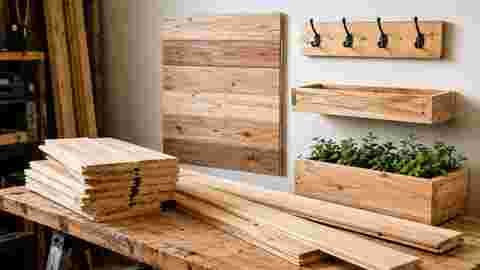
Project 1: Build a small T&G accent wall
This is one I have actually done.
I had a bunch of three-foot and five-foot pieces left from a job, along with some full boards that were left over because the job had been over-ordered. There was enough good material there to build a small accent wall without buying another load of boards.
That is a good use for mixed longer leftovers because the wall does not have to be huge. A narrow section behind a bench, a small entry wall, a nook, or another contained area can use shorter lengths without making the job look pieced together.
Lay the material out before you start. Put the best-looking boards where they will be most visible. If the pieces vary in length, decide whether you want clean full-width runs, staggered joints, or to trim the project down to a size that lets the available pieces work naturally.
The T&G profile is doing real work here because it helps the boards register together and gives you the same finished face you would have on the original installation.
The mistake is stretching a mixed scrap pile across a wall that is too big for it. Keep the project sized to the material and the finished result will look deliberate instead of patched together.
Project 2: Make a planter box from longer boards or full leftovers
A planter box is another place where leftover boards can earn their keep.
If you have full boards or decent longer lengths, you do not necessarily need the tongue on every edge. You can rip or cut off the tongue where it gets in the way and use the board as regular stock for the sides, trim, or decorative wrap.
You can also use the T&G as the visible skin while the actual planter structure handles the load and moisture. The profile can make the outside look finished; it should not be asked to do a structural job it was never meant to do.
That distinction matters. The leftover T&G can be the finished skin or part of the box, but the project still has to be built for where it is going and what it will hold.
The same idea works for a simple indoor planter sleeve or decorative box around a separate container, where the wood is mostly doing appearance work.
Project 3: Build a wall-mounted hook or key rack
This is a good job for shorter clean pieces.
Take a few boards, join them into a small backer panel, square the ends, and mount hooks to the finished backer. The T&G gives the panel some texture without needing another decorative layer.
This works well for keys, hats, dog leashes, light shop gear, or entryway storage depending on how the rack is mounted and what hardware is used.
If you only have one wider piece or a couple narrow leftovers, keep the rack small. It does not need to become furniture.
That is the advantage of a small rack: one or two clean leftovers may already be the right scale for the job.
Project 4: Make a charging-station or tool-wall backer
A few leftover boards can make a clean backer behind chargers, small shelves, hooks, or a tool-storage area.
This is one of those projects where the T&G profile makes sense because several narrow pieces can turn into one finished-looking panel pretty quickly.
Build the panel to fit the area you already use. Let the T&G be the finished backer, then fasten chargers, hooks, or shelving into backing or framing that can actually carry the load.
That gives you a useful shop or mudroom project without needing a large amount of material.
Project 5: Turn short pieces into shelves and risers
Not every shelf needs to span a room.
A good leftover board can become a short display shelf, a small ledge, a pantry riser, a coffee-station riser, or a platform that gets something off a counter or bench.
If the tongue or groove makes the edge awkward, trim it off. The fact that the board started life as T&G does not mean every finished project needs to show the joint.
That is a useful rule for the whole scrap pile: keep the part of the board that helps the project. A factory tongue or groove is not sacred if trimming it off makes the piece work better.
Before the next project creates another scrap pile
Get the free 10-page T&G Project Starter Guide before you buy the next batch. It gives you one place to check planning, materials, tools, installation decisions, and the mistakes that are cheapest to catch before the boards go up.
Project 6: Use T&G for a cabinet, nook, or recessed-panel accent
A small panel inside a cabinet, behind open shelving, in the back of a nook, or inside a recessed area can use surprisingly little material.
This is where matching matters more than quantity.
If you have several pieces from the same job, the color and finish are usually already close enough to work together. Join the pieces into a small panel, trim the outside edges cleanly, and let the repeated T&G lines do the visual work.
Do not mix three different finishes just to empty the scrap pile. A smaller, coherent panel will usually look better than a larger project that advertises every mismatch.
Project 7: Build a small storage box or tray
Longer offcuts can be ripped down or have the tongue removed and used as sides for a small box, tray, or organizer.
This is another case where you do not need to preserve the original profile unless it helps the design.
A shop tray for fasteners, a small catch-all, a shelf-top box, or a simple organizer can use narrow strips and short pieces that would never make sense on another wall.
Keep the project simple. Square parts, clean cuts, and decent sanding will do more for the final result than trying to make the piece complicated.
Project 8: Make shop helpers from the small stuff
The smallest usable pieces do not have to become decorative projects.
They can be some of the most useful leftovers in the pile.
A cutoff may become a tapping block, spacer, protector, setup piece, finish sample, stain sample, drill-test piece, saw setup piece, or a sacrificial block you use so the finished material does not take the abuse.
This is where my grandfather’s point really applies. A piece does not have to end up hanging on a wall to still save you money or trouble.
If it can protect the finished work, help you set up a cut, or let you test something before touching the good material, it still has value.
Paint-grade and stain-grade leftovers are different animals
Paint-grade material gives you more room to work.
You can fill small defects, sand the piece, trim ugly edges, and paint the finished project. Stain-grade or clear-finished leftovers need better matching because grain, dents, color changes, and finish damage stay visible.
Save your best-looking pieces for the projects where the wood is going to be part of the finished appearance.
Use rougher but still sound pieces for painted projects, hidden backing, shop use, or setup pieces.
If the leftover pile is pushing you back into material-selection questions, see How to Choose the Right Wood for Tongue-and-Groove Ceilings.
Do enough prep that the project looks intentional
Leftover material still needs to be treated like finished material if it is going inside the house.
Cut off damaged ends. Remove a tongue or groove if it hurts the project. Sand the parts that need it. Ease sharp or damaged edges where appropriate. Lay out the boards before you fasten anything.
A good leftover project should look like the material was chosen on purpose—not like the only goal was getting rid of a pile.
That is the line.
Know when to quit trying to save a piece
Some material is just done.
If a piece is badly split, twisted beyond what the project can tolerate, rotten, contaminated, too short to safely work with, or otherwise not worth trusting, throw it out.
The goal is not to save every scrap.
The goal is not zero waste at any cost. It is getting the reasonable value out of sound material before calling it trash.
That is a much different rule.
Video: Useful projects from scrap wood
Want the full tongue-and-groove install order in one place?
I put the layout checks, prep work, tool judgment, fastening sequence, and common mistake fixes into one practical PDF handbook so you are not guessing your way through the job.
Bottom line
Leftover tongue-and-groove wood can become a lot more than a pile in the corner.
Full boards and longer pieces can become accent walls, planter boxes, panels, shelves, and storage projects. Mid-length scraps can become hook racks, charging-station backers, cabinet accents, risers, trays, and organizers. The small stuff can still earn its keep as tapping blocks, spacers, protectors, and test pieces.
I have used leftover three-foot and five-foot pieces, along with full boards from an over-ordered job, to build a small accent wall. That is the kind of reuse I am talking about.
Do not build junk just to say you saved the wood. But do not throw away sound material just because the main job is finished.
Use what still has a job left in it.
For the broader T&G basics, see Tongue and Groove: Everything You Need to Know.